For the person reviewing the pull request
Approve agent work with evidence.
See what changed, what Treft checked independently, and what still needs your judgment. From your phone or browser.
Nothing ships without your approval.
No card · start with one repo · no branch-rule changes
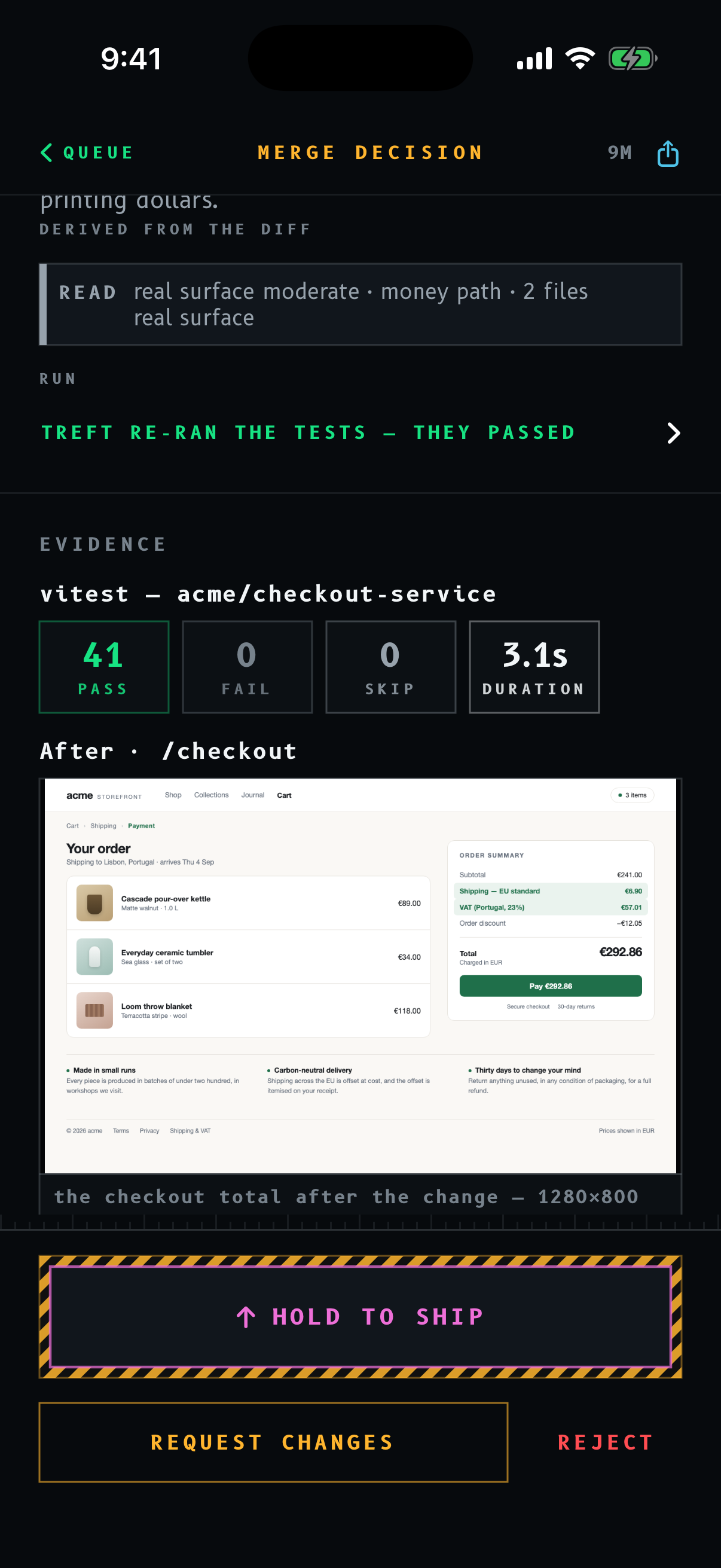
Know where to spend your attention.
See what passed, failed or could not run.
Inspect the tests and supporting evidence.
Request changes or deliberately approve.
One product. Your next job.
Keep work moving.
Keep the final say.
Bring a pull request from any coding agent or a colleague. Or ask Treft to make a small change.
A queue you can work through
Check the relevant changes and independent evidence. Send a precise concern or approve the work.
A small change, away from your desk
Describe it, follow the run, then inspect the result. Voice on mobile; text in your browser.
A second look at a public PR
Free independent verification for public repositories. Find out what the tests actually establish.
AI change control
From open PR
to an informed decision.
Connect GitHub. Treft re-runs the exact patch in a fresh sandbox, grades the evidence, and shows you where to look before you merge.
-
Choose one repository
Connect through the GitHub App. You choose which repositories Treft can access and can revoke access later.
-
Inspect the independent result
Treft checks the patch in a fresh clean room with kept tests restored from base. An agent’s summary is separate from that evidence.
-
Make the call
Read the change, request a revision or approve. Marking a hunk reviewed does not merge it. You approve every merge. A new commit needs fresh evidence.
Ask Treft for a small change. Review the result.
Evidence, with its limits
A passing test is useful.
It is not a guarantee.
Tests can miss the wrong behavior or a change you never asked for. When a check fails or cannot run, Treft says so. Your judgment remains part of the process.
How verification works →The measurements are public
We publish our verifier’s false-pass rate — measured against gold, published with confidence intervals. Others publish figures for benchmark tasks. Ours is measured on real repositories, against their own test suites.
How often a passing run is still wrong: 15.4%, on a census of 389 verified passes across 38 production JS/TS repositories. Measured where we could measure hardest, then measured again across Go, Python and Rust: every interval overlapped it.
GitHub’s Copilot coding agent alone created over a million pull requests between May and September 2025 (GitHub Octoverse · 2025). More output makes a considered review more valuable.
At your desk. Out in the world.
The same work.
A screen that suits you.
Write instructions and review files in the browser. Use mobile voice input and the native hunk deck on your phone.


Start with a sample or your own PR
Explore the sample without connecting a repository. When you are ready, sign in and choose a repository to see your own work.
Treft for iPhone is on the App Store. Treft for Android is on Google Play.
Open the browser app →Clear limits, before you run
Free includes 50 pull-request verifications a month and $5 of one-time usage credit, no card. Public repositories: verification is free, forever. Agent code-generation runs and private usage have separate limits. Pro is $29.99 a month.
See pricing →Your first useful result
Start with one pull request.
Find the evidence. Read the change. Decide what happens next.